Sovereign Debt –A Crisis With No Easy Fix
 Nov 2026 Issue
In this issue:
- Leading economies facing the debt wall
- Canada showed a national debt crisis can be solved
- Exorbitant privilege of the US has given it more leeway but limits are apparent
- Markets are looking for governments to show some adherence to fiscal prudence
Over the past two decades, the leading industrialized economies of the G7 have undergone a profound structural change to their national balance sheets. Once characterized by reliable economic expansion and relatively manageable balance sheets, the world’s leading advanced economies—the United States, Japan, Germany, the United Kingdom, France, Italy, and Canada—have collectively entered an era of unprecedented public indebtedness. Between 2006 and 2026, national debt levels across the G7 migrated from a mere policy concern to a systemic constraint that has fundamentally redefined the limits of state power and fiscal intervention.
Warnings about the rise in the national debt of leading economies has been a constant that fluctuated between urgency and the backburner for most of the G7 nations. Canada’s experience in the 1990s helps illustrate when urgency to fix the national debt became a focus of policymakers. In 1994, the Canadian government was faced with a rising national debt that the government had promised would be tackled. The government has laid out a framework to cut the budget deficit to 3 percent of GDP over a 2-year period. Interest costs were absorbing a third of the federal government’s total revenues but that was not sufficient to the bond market which had been financing the debt and annual deficits of the Canadian government.
Against this climate, government officials were left in shock in 1994 when a regular government bond auction held to raise capital for the government’s spending needs produced no bids. At the last moment, as the auction window closed, some bids arrived but the writing for the Canadian government was on the wall and the national credit card had been maxed out. The ability to continue rolling over debt was no longer a given and the bond markets could no longer be ignored.
Canada Showed the Way Forward
By early 1995, Canada got tough on spending. Cuts to the budget outweighed tax increases by about 7 to 1. Program spending was cut by about 12 percent; about 15 percent of the public service was eliminated and large reductions were made to foreign aid, unemployment benefits and health care.
Within 3 years, Canada’s budget was back in surplus and stayed that way for a decade. Federal spending as a share of GDP fell to levels last seen in the 1950s and the debt to GDP level was down to 29% by 2008 and Canada had regained is AAA credit rating that it had lost a decade earlier. Then Finance Minister Paul Martin, who went on to become Prime Minister of Canada, later summarized his goal was not only to please the bond market but to get to a position where the government could “tell the bond market to get lost.”
Unfortunately for Canada, the progress that made it a beacon for fiscal stewardship was not able to last. Canada has reversed the progress it had made in paying down its debt and being able to reward citizens with tax cuts. Its debt to GDP went from 78% in 1996 to 39% in 2007, but has once again rebounded to 65%. It is enviable compared to Europe and the US but unlike the 1990s – Canada is also seeing economic stagnation that is starting to become persistent while its society has aged, and household debt has doubled as a percentage of GDP.
The Long Arc to Fiscal Insolvency
The road to fiscal insolvency has been one that has its roots in the post-WWII recovery. As nations rebuilt themselves and the US used its unmatched resources for the Marshall Plan to rebuild Europe and Japan, voters also wanted their governments to provide enhancements to the social safety net in terms of retirement and healthcare. When the G7 nations had young populations and high economic growth rates, the respective governments were able to meet the needs of their populations. Today, ageing societies and a structurally low-growth economy are creating fiscal challenges for developed economies
The Long Arc to Fiscal Insolvency
The road to fiscal insolvency has been one that has its roots in the post-WWII recovery. As nations rebuilt themselves and the US used its unmatched resources for the Marshall Plan to rebuild Europe and Japan, voters also wanted their governments to provide enhancements to the social safety net in terms of retirement and healthcare. When the G7 nations had young populations and high economic growth rates, the respective governments were able to meet the needs of their populations. It must be remembered that during this time, the Korean War was underway and soon to be followed by the Vietnam War. These wars took place under the dark shadow of the Cold War – which required immense defense spending.
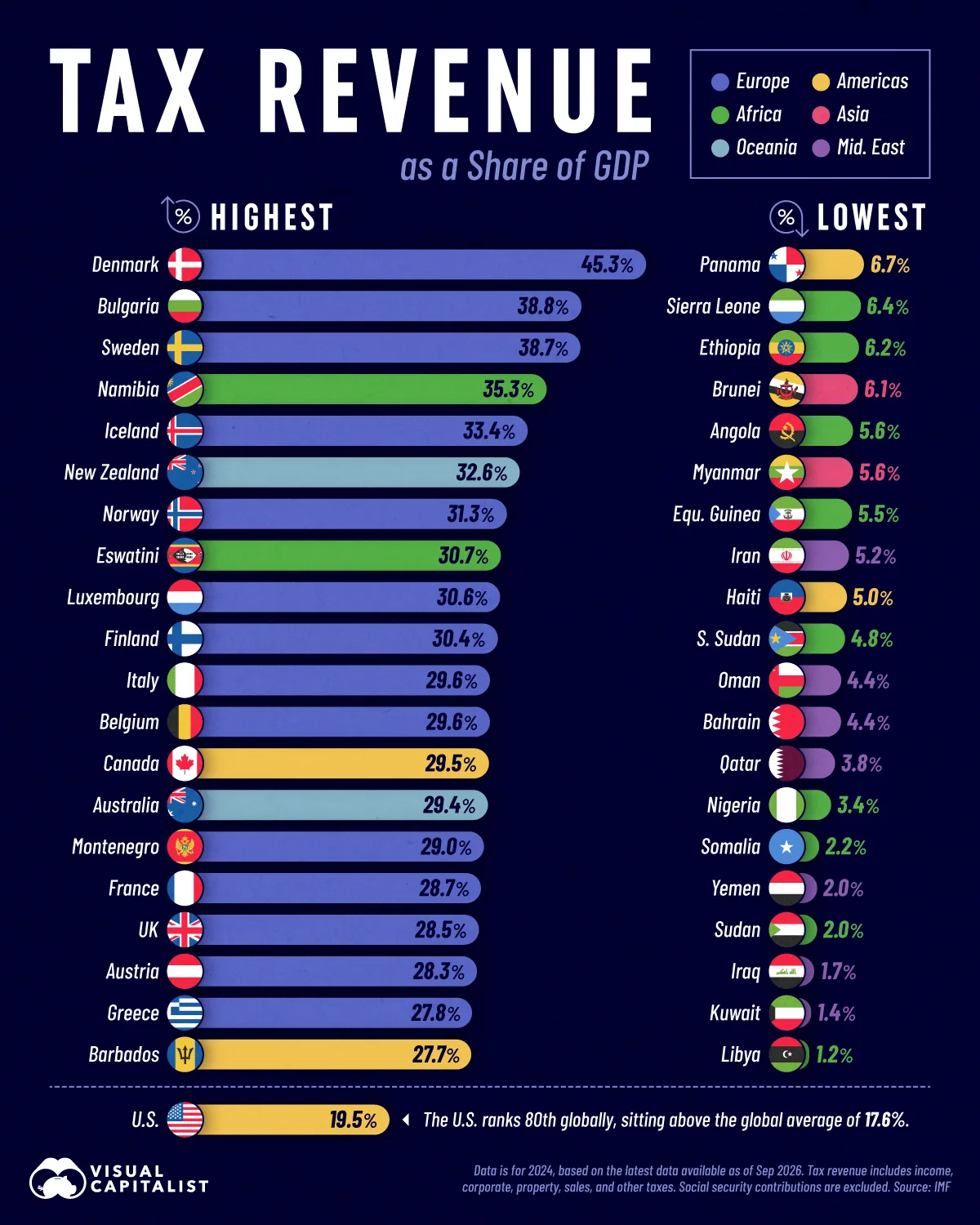
As the accompanying chart shows, most of the G7 nations have tax burdens as a percentage of GDP that are much higher than the global average. Policymakers in the G7 nations have limited scope to raise personal income taxes as some already have top marginal tax rates exceeding 50%. If they raise taxes much further, it is likely that they will end up raising less tax revenue. The International Monetary Fund (IMF) recognizes that there is only so much room to raise taxes and actually collect more tax revenue since high taxes weaken incentives to work, save and invest.
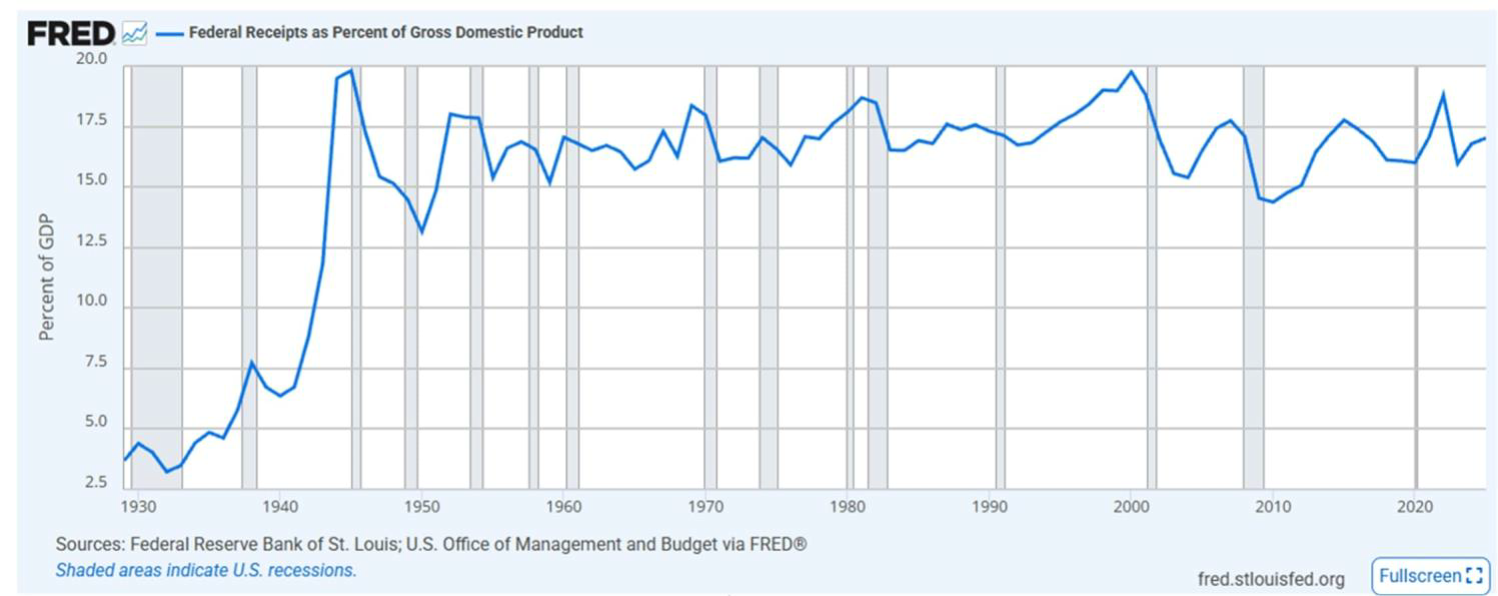
As the chart on shows below, federal tax receipts as a percentage of GDP have remained under 20% even when the top marginal tax rate was over 90% in the 1950s, over 70% in the 1960s and over 70% in the 1970s. By the end of the 1980s, the top marginal tax rate had fallen all the way down to 28% and tax revenues as a percentage of GDP stayed relatively constant over the decades.
In the US, the debt to GDP ratio sits at 121%. The prior peak of 115% was achieved during WWII. By 1980, steady economic growth saw the debt to GDP ratio fall to its post WWII low of 31%. The spending to bail out the banking system and help the economy during the Great Financial Crisis saw the debt to GDP ratio rise from 62% in 2007 to 99% by 2012. It sat at that level until the arrival of the pandemic, which pushed the debt to GDP ratio to 126%. Gradually, the ratio declined to its current level of 121%. While this decline is a small achievement, it also shows the resiliency of the US economy as economic growth has generated much needed increase to tax revenue for the US government. Despite enormous tax cuts enacted by the One Big Beautiful Bill (OBBBA) and rising interest costs and defense spending, the growth of the US economy has allowed for the debt to GDP ratio to fall slightly despite the fiscal headwinds.
The Exorbitant Privilege
Nations have cast an envious eye towards the US for its ability to run large budget deficits while keeping taxes lower than other nations and even offering tax cuts much more readily than other nations were able to offer their own citizens. This luxury came to be known as the “exorbitant privilege” – a phrase coined in the 1960s by the French finance minister. The privilege stems from the fact that the US dollar is the dominant international currency – it is the main currency for international trade and foreign exchange holdings of many nations. The role of the dollar meant that other nations had to accumulate US dollars that kept a steady bid under the US dollar. Weaker nations that run budget deficits cause anxiety amongst international investors and their currencies can plummet – which keeps the finance ministers mindful of not allowing budget deficits to rise too fast without credible plans to keep red ink in check. The United Kingdom found out what happens to a nation without the “exorbitant privilege” in the fall of 2022. The UK government published its “Growth Plan” which called for halting a proposed rise in corporate taxes and cutting personal taxes with a provision for energy subsidies for businesses and households. The government proposed that borrowing to pay for the tax cuts would stimulate the economy and in time – generate enough new tax revenue to pay for the proposed cuts. But instead, the financial markets rebelled by sending UK bond prices sharply lower as they sensed credit risk and this led to a sharp rise in interest rates. Within a month, the Prime Minister and Chancellor of the Exchequer (Finance Minister) resigned, and the proposed tax cuts were scrapped. Recalling that painful episode is why the UK Treasury has gone out of its way to state that the upcoming budget update from the US government will show that fiscal discipline will underwrite every promise that the government makes.
Today, France has quickly moved to the top of the worry list. The International Monetary Fund is sounding the alarm that France’s persistently large deficits are a worry. The IMF’s managing director, Kristalina Georgieva, stated in a recent interview that France needs to cut its budget deficit to show lenders that the country has budget credibility. France’s budget deficits have been over 5% of GDP in five of the past six years and the European Central Bank (ECB) expects no relief for at least the next 2 years. Georgieva went on to say, “What we see in France is a complication of, on one side, the consequence of borrowing shock after shock after shock, climbing on this staircase that does not lead to heaven, and on the other side, a political dynamic scene in France that creates more difficulties for the finance ministry to put a clear path for tightening.”
Perhaps following the Canadian playbook from the 1990s – or really, the only playbook available to a nation without the “exorbitant privilege” the French government has signaled it will be raising taxes and cutting spending by reducing benefits for retirees and other pensioners that are accompanied by cuts to social programs. Complicating things for the French government and causing some fear amongst the bond investors holding French debt is the fact that France’s government is divided and forging a consensus is difficult at the best of times. Further complicating things for France is the fact that France is currently in the throes of another political crisis, with violent student protests expanding into wider segments of society. Political instability in France has put pressure on the country’s government bonds, known as OATs. Investors now demand a higher yield than they do for bonds issued by the Italian government, with French 10-year bond yields.
Bond Markets – Overreacting or Reacting
The consensus within the financial markets is that profligate governments are spending too much at a time that inflation worries continue. But it is more than likely that there is a combination of reasons for the upward push in interest rates. While inflation is a valid concern, it is worth noting that in the US – inflation has been stuck in the 3% range. Some months, the inflation data shows inflation below that level and some months shows slightly above 3%. While it is not at the 2% level that the US Federal Reserve has stated it wants inflation to decline towards, it is not exactly a crisis – at least not yet.
Often forgotten in the media headlines is the fact that the benchmark US ten-year Treasury bond yield tends to approximate the nominal GDP growth rate. For example, the last five quarters of economic data shows that nominal year over year GDP growth in the US has been recorded as 4.6% (Q2 2025), 5.4% (Q3 2025); 5.4% (Q4 2025); Q1 2026 (6.1%) and Q2 2026 (6.6%). Similarly, the US 10-year US Treasury rate is about 5.1% – about where it should be based on history. In the European Union, nominal GDP growth rates for the same quarterly periods show year-over-year growth rates of about 3.2%. With inflation averaging slightly below 3%, then real economic growth in the European Union is nearly 0%. Economic growth is a constant challenge for European policymakers. It has been unable or unwilling to make the structural changes necessary to fix a nearly 20-year problem. Data from Eurostat shows that over the last 20 years, the European Union has averaged annual real (inflation adjusted) economic growth of only 1.9 percent. This is not enough to fix the rise in the national debt levels of European nations – hence we are seeing the issues surrounding France. The United Kingdom – once the lone bright light of European economic growth – is not far behind France.
The Canada Roadmap
During a campaign stop, Texas Senate candidate Ken Paxton was quoted in leaked audio recordings as saying that policymakers must be honest with the voters and dealing with the US national debt will require “Making some reasonable cuts to mandatory spending – you’re gonna have to do it. Or there is no solution. That’s just the reality. We have to suck it up. From Republican presidents to Democrats,
we’ve been spending like crazy and no one seems to care. It’s gonna bankrupt us. It’s just a matter of time.” The last time anyone in politics spoke this honestly about the US national debt was when Ross Perot – another Texan – ran for president in 1992 and briefly topped the polls as voters responded to his worries about what the rise in the national debt would do to future generations of Americans. Like Perot, Paxton does not want to rely on the “exorbitant privilege” as the easy way out.
While the US has costly military obligations that other nations do not have given its security alliances and economic interests, it also has a much easier path to getting a handle on its national debt compared to Europe, Japan or Canada. This is because the US economy is more dynamic than the rest of the G7 nations and is growing faster. In addition, the US has a much lower tax rate than other nations and therefore has much more room to raise taxes. For the US to follow the Canada roadmap, it will take political agreement from both parties to combine spending cuts with some tax increases. If the US economy can continue its current growth rate for the next several years, these three factors can bring the US budget deficit down and reassure markets.
Current data shows that the US national debt is costing the Treasury about $3 billion per day in interest payments. Looking at the current $7 trillion US budget, the entitlement programs (Social Security, Medicare and Medicaid) categorized as mandatory spending comprise about 60% of the budget; discretionary spending (defense and non-defense spending) is 27% of the budget and 14% of the budget is on interest costs.
Some politicians have said that the US can grow its way out of its fiscal problems. That is unlikely according to the non-partisan and non-profit Committee for a Responsible Federal Budget. Its calculations have found that if the US economy could maintain its current spending and trajectory, it would require a sustained economic growth rate of 3.3% (after inflation) just to hold debt to GDP flat at 100%. In order to tame the annual federal deficit to a manageable 3% of GDP, the US real economic growth rate would need to rise to 4.4%.
While these economic growth rates are in line with the latest economic growth rate levels in the US, it is difficult to see if these rates will be sustained. The US economy has achieved the 3% growth rate in only five calendar years since 2000.
As always, the debate around the national debt in the US will come down to a trade off between spending cuts and tax increases. The reality is it will take a combination of both – as Canada did once before. The chart on page 3 shows that US federal tax revenues as a percentage of GDP has not exceeded 20% regardless of how high the top marginal tax rate was. In the Eisenhower years, the top marginal tax rate was 91% but the tax code has many loopholes to lower the actual tax paid. In the Reagan years, the Tax Reform Act of 1986 slashed the top tax rates down to 28% and scrapped tax shelters and still tax revenue did not exceed 20%.
Markets Need a Reason for Confidence
The uncomfortable reality is that there is no easy way out of the sovereign debt problem. Debt burdens can be reduced through stronger economic growth, spending restraint, higher taxation or inflation, but each solution carries economic and political costs. The greatest advantage enjoyed by countries such as the United States is therefore not simply their ability to borrow, but their capacity to grow. For Europe, Canada and Japan, weaker structural growth makes the arithmetic considerably more difficult. The lesson of Canada in the 1990s is that governments retain considerable control over their fiscal destiny, provided they act before financial markets force the issue. For investors, the important question is not whether governments can continue borrowing tomorrow, but whether their economies can grow fast enough to prevent rising debt-service costs from steadily narrowing their choices. It is unlikely that the structural challenges to economic growth in Europe, Canada and Japan will allow them to grow their way out of their debt problems. In the years ahead, fiscal credibility and economic growth may prove every bit as important to financial markets as inflation and monetary policy.