The Coming Global Population Crunch
 Aug 2026 Issue
In This Issue:
- Global population on course to peak within 50 years to 75 years
- Many industrialized nations are facing the demographic cliff
- China, Japan and South Korea ageing
- Migration will not offset population decline
In 1798, the British scholar Thomas Malthus published An Essay on the Principle of Population. Malthus argued that the human population had a natural tendency to grow faster than the means of subsistence. In his era, subsistence largely meant food production. His central concern was that population growth would eventually overwhelm the world’s ability to feed itself.
Today, the data increasingly points toward the opposite risk. Malthus’ forecast of widespread famine and misery did not materialize. Since his time, the global population has risen roughly tenfold, while food production has expanded dramatically through advances in farm productivity, seed genetics, fertilizer, mechanization, logistics, and trade.
Malthus Was Wrong – Thankfully
Malthus was wrong, thankfully, in predicting catastrophic food shortages and global famine. History shows that food production has trended upward. Recent agricultural data continues to reinforce this point. India’s Ministry of Agriculture has reported record food production, up 5.3% from the prior year’s record, supported by favourable rainfall, improved technology, and better seeds. Brazil has also reported a record total grain harvest, while China’s summer grain production reached a new high as higher yields offset slightly lower planted acreage. Record wheat production in Argentina, Turkey, and Egypt has also contributed to strong global supply.
Although Malthus was wrong about food production, concerns about overpopulation have persisted for decades. The global population reached 5 billion in July 1987 and has since climbed to an estimated 8.3 billion, adding roughly 1 billion people every 11 to 12 years. For many observers, the combination of rapid population growth, environmental degradation, and pressure on finite resources appeared to set the stage for a modern Malthusian challenge.
Global Population Growth Decelerating
Yet once again, the Malthusian proposition is being challenged by the data. While the world has added population rapidly since 1987, annual growth has slowed materially and is now approximately 68 to 70 million people per year. The United Nations expects the global population to peak at roughly 10.3 billion in the mid-2080s before gradually declining to about 10.2 billion by 2100.
At the aggregate level, these projections may appear manageable. The more important issue, however, is the divergence beneath the global total. Current data from the United Nations shows that one in four people in the world live in a nation whose population is considered to have peaked. United Nations data indicates that population levels have already peaked in 63 countries, including several pillars of the global economy. China, Japan, Germany, and Russia have likely already passed their demographic high-water marks. Another 48 countries are expected to reach peak population within the next 30 years. For investors and policymakers, the country-level distribution of population decline matters more than the global headline number.
The UN projections represent a middle range among major demographic forecasts. By contrast, The Lancet has projected that global population could peak by 2063 at only 9.7 billion people – 37 years faster than the UN projection of 2100. The Lancet also predicts that after peaking in 2063, the population would be 8.8 billion in 2100 – nearly 1.4 billion people less than the UN projection. Put differently, under The Lancet’s projections, the world’s population in 2100 would be roughly equivalent to the level expected by 2031. We have long emphasized the hazards of forecasting in almost any field, and history is filled with confident predictions that proved wrong. However, demographic decline is no longer just a distant forecast. In many major economies, it is already visible in real time.
Economic Implications
The UN population projections and those of The Lancet have some staggering implications. If The Lancet forecasts are closer to the eventual outcome, the economic impact will be severe. The Lancet scenario is several degrees more alarming than the UN forecast because it implies significant challenges that would arise from ageing populations and faster declines in the working-age population.
Economic growth depends heavily on the size and productivity of the working-age population. Under both the UN and The Lancet projections, many leading and middle-income economies are likely to face shrinking workforces and rising old-age dependency ratios, meaning more retirees supported by fewer workers. This reduces potential economic growth unless offset by higher productivity, technological advancement, automation, artificial intelligence or longer working lives. The Lancet scenario would intensify these pressures by implying a smaller global market, earlier workforce shortages and more severe constraints in high-income regions.
Lower workforce growth also has direct implications for government finances. Fewer workers will be available to support a growing elderly population through taxes, pension contributions, healthcare spending and long-term care costs. This combination points to a future of greater fiscal pressure, with governments likely forced to consider some mix of higher taxes, later retirement ages, benefit reforms, productivity-enhancing investment or increased public debt.
Asia’s Peak Population Challenge
Japan remains the clearest example of advanced demographic contraction. Its population peaked at approximately 128 million in 2008. The 2025 national census recorded a population of 123.05 million, including foreign residents, representing a decline of 3.1 million, or 2.5%, from 2020 levels. This was the largest drop since census records began in 1920, with only Tokyo and Okinawa recording population gains. Data from Japan shows that deaths outnumber births and the birthrate is now at a record low with the aged 65+ population standing at nearly 30% of the total. At the pace of current trends, Japan’s population is expected to fall by 30% by 2070.
Japan’s experience reduces some of the uncertainty about the implications of population decline for other nations, because the consequences are already observable. The country has experienced prolonged low growth, a shrinking labour force, a multi-decade deflationary malaise, and a sharp rise in its national debt to more than twice the size of its economy. Healthcare and pension costs have been major contributors to this fiscal burden.
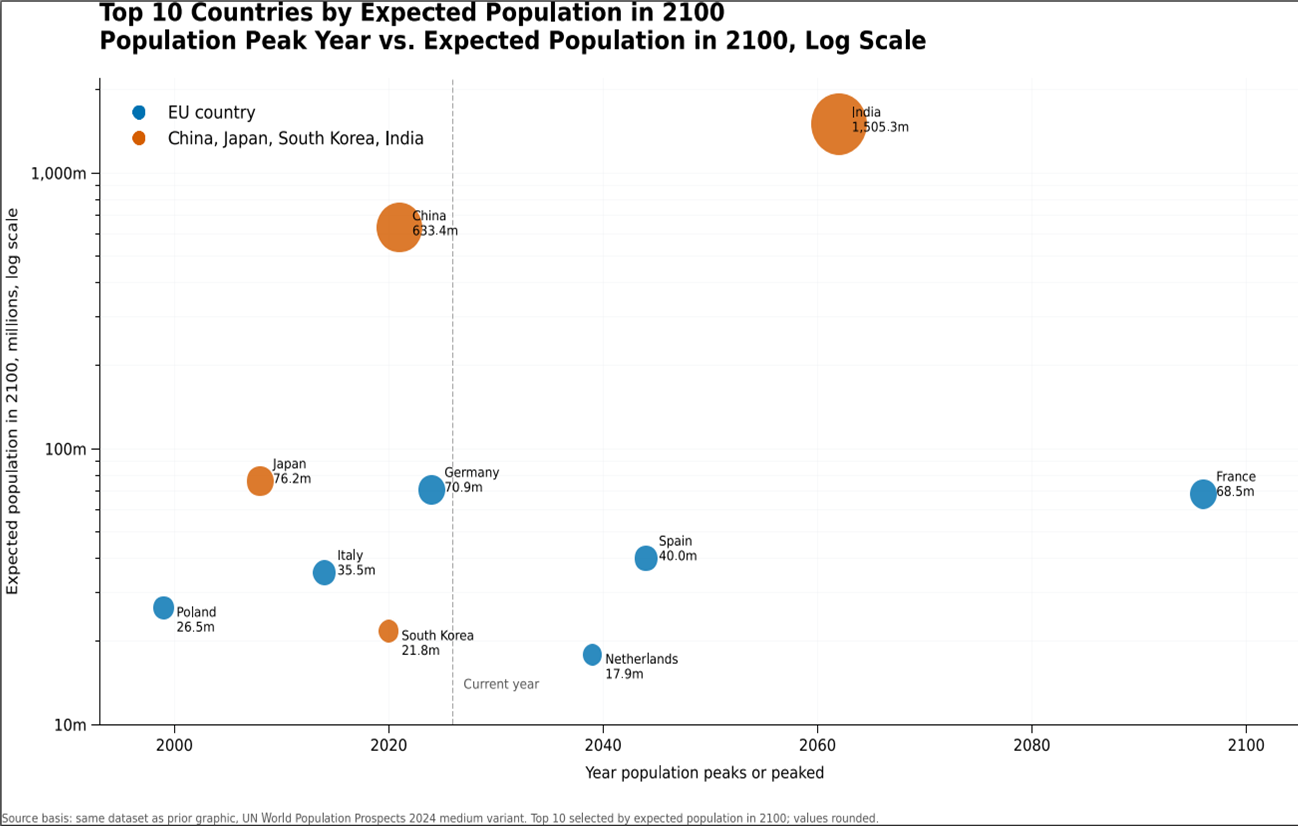
As the chart shows below, India’s population will peak in less than four decades and China, Japan, South Korea and Italy have already peaked. The chart also shows that the population of China will be less than half of today’s 1.4 billion level by the end of this century.
Geopolitical Implications
The ageing and eventual decline of the global population will also have meaningful geopolitical implications. Demographics influence relative economic scale, military capacity, alliance structures, migration pressures, and the balance of influence between nations.
China is an useful example. One of its longstanding geopolitical advantages has been its population scale relative to neighbouring countries. Although India has now surpassed China as the world’s most populous nation, China still maintains the largest active military in Asia, according to the International Institute for Strategic Studies. Upper estimates suggest China has as many as 2.5 million active-duty personnel, roughly 1 million more than India. Over the coming decades, however, China’s demographic trajectory could make this advantage harder to sustain.
The Lancet study forecasts that India’s population will peak at 1.61 billion in 2048 (a 9% increase from current levels before it peaks) and will fall to 1.09 billion by 2100 (a drop of almost one-third in about 50 years after it peaks!).
Comparing India’s population to China’s data shows that China is thought to have peaked in 2024 with a population of 1.43 billion and this will fall by almost half by 2100 to about 730 million people. Official data from the Chinese government shows that the population fell by 3.39 million people in 2025 and births of 7.92 million were less than the level of deaths which reached 11.31 million and birth rates are at a record low.
For two countries that together represent roughly one-third of the world’s current population, a scenario in which both are far below their peak populations by 2100 would carry significant implications for Asia’s economic and geopolitical future. China is currently the world’s second-largest economy while India ranks sixth. The demographic path of both countries will influence labour supply, consumption, savings rates, military capacity, and regional power dynamics.
For decades, China was able to use its army of workers to power its factories and manufacturing capacity. But a common saying in China is that it will “get old before it gets rich.” Like Japan, its working age population is shrinking. Within the last decade, China’s government had advocated for a switch of its economic strategy to one focused more on domestic consumption rather than being overly export oriented. But with a rapidly ageing population, the next two decades and more will make it harder than first thought to switch its economic model to one focused on consumption over exports.
South Korea faces an even more acute demographic challenge. Its population peaked in 2020 at approximately 51.7 million and is projected to fall by about 30% to roughly 36 million by 2072. Government projections suggest that people aged 65 and older could represent nearly 48% of the population by then. For an export-driven economy known for its manufacturing strength and technological leadership, the implications are significant. Sustaining growth will likely require substantial investment in automation, productivity-enhancing technology and future productive capacity.
Europe – More Nuanced Than Asia
Europe’s population challenges are more nuanced, partly because immigration has offset some of the pressure from low birth rates. The European Union has a population of roughly 450 million, but its underlying demographic momentum is weak. Birth rates are approximately two-thirds of the level required to maintain a stable population. Recent EU data also shows that annual births have fallen to about 3.5 million, roughly half the 1961 level of 6.8 million.
The EU population is projected to peak at approximately 453 million in 2029 before gradually declining to below 400 million by 2100. At the same time, life expectancy is expected to rise meaningfully, creating a larger elderly population, and reinforcing negative demographic momentum. Even if birth rates improve, the current age structure means deaths can continue to exceed births for an extended period. This dynamic has already been visible in Europe, where deaths have exceeded births since 2012. Within Europe, Eastern and Southern European nations have experienced significant outflows of young, working-aged people seeking better economic opportunities in Western and Northern Europe.
Migration – Only a Partial Fix
Data from the OECD and various European academic studies suggest that immigration can mitigate and delay demographic decline in the short to medium term, but it is not a complete long-term solution. First-generation immigrants from higher-fertility regions such as Africa, the Middle East, and South Asia often have higher birth rates than native-born populations. By the second generation, however, fertility rates tend to converge toward those of the host country as families adapt to local norms, education levels, economic conditions and labour market participation patterns. The overall boost to a nation’s birth rate from higher migrant fertility is therefore typically modest.
The Canadian Experience
Canada provides a useful case study. In recent years, Canada expanded immigration faster than any other G20 country in an effort to support economic growth and address labour shortages. The results were mixed. Higher immigration helped fill roles in areas such as transportation, warehousing and healthcare—including elder care. However, Canada’s weak productivity performance and poor per-capita income growth limited the broader economic benefits. At the same time, the rapid population increase placed pressure on housing, healthcare access, education and public infrastructure. As former Prime Minister Justin Trudeau acknowledged, “We didn’t get the balance quite right.”
More recently, weaker economic opportunity and more restrictive immigration policy have contributed to some newcomers leaving Canada or reconsidering long-term settlement. A recent report from TD Economics has raised the alarm bells amongst Canadian economists has it warned that Canada is losing it highest-skilled workers, entrepreneurs and STEM graduates to the US. The TD study says that Canada is unable to attract and keep talent. For an ageing society this has economic implications. TD states “Canada will continue to be a feeder system for the US innovation economy.”
Demographic Decline Is New Ground
For an issue with such profound implications, demographic decline receives surprisingly little attention. The consequences will extend across economic growth, fiscal policy, labour markets, healthcare systems, social cohesion and geopolitical power. For investors, the key point is not that population decline guarantees poor outcomes. Rather, it changes the conditions under which countries, industries and companies must compete. Economies with shrinking workforces will need to rely more heavily on productivity growth, innovation, automation, capital discipline and effective policy choices. Those that adapt well may still prosper; those that do not may face slower growth, higher fiscal pressure and diminished global influence. Demographics are not destiny, but they are a powerful starting point for understanding the long-term investment landscape. The challenges are easy to see and they will have to be overcome with more advancements in technology and productivity.